Overview
The Malaysia national football team (commonly known as Harimau Malaya) represents Malaysia in international men’s football. Controlled by the Football Association of Malaysia (FAM), the team has a long history that spans the pre‑ and post‑independence eras, regional successes in Southeast Asia, periodic appearances in continental competitions, and a passionate domestic following.
History
- Early years and British era (pre‑1957): Football in Malaya was organized under colonial structures; representative teams from the Malay states and the Malaya national side played friendlies and regional fixtures. The Malaya team won several editions of the Malaysia Cup and competed in regional matches against neighbors such as Singapore and Thailand.
- Post‑independence and 1950s–1970s (the golden era): After independence in 1957, Malaya became Malaysia in 1963 and the national side developed rapidly. The team qualified for and competed strongly in regional competitions. Malaysia’s most notable early achievement was qualification for the 1972 Munich Olympics football tournament — the team played in the final tournament and earned worldwide recognition for that qualification.
- 1980s–1990s: Malaysia remained a regional force in Southeast Asia, with strong showings in the Merdeka Tournament (an important invitational competition in Asia) and the Southeast Asian Games. The domestic league and cup competitions were important talent pipelines.
- 2000s–2010s (rebuilding and regional rivalry): The 21st century saw mixed results: Malaysia continued to contend in AFF Championship (formerly Tiger/Cup) and SEA Games, with peaks including winning the AFF Suzuki Cup in 2010 at the U‑23/under‑age level and strong U‑23 teams. The senior team’s notable achievement in the modern era was winning the AFF Championship in 2010 (as hosts/contenders — see successes below) and strong performances in regional tournaments.
- Recent years: Malaysia has been investing in youth development (academies, Professional Football League improvements) and international coaching. The team has regained competitiveness in Southeast Asia, producing promising youth cohorts and achieving improved FIFA rankings at different times. Domestic reforms aim to raise standards and bridge the gap with stronger Asian teams.
Major successes
- Olympic qualification (1972): Malaysia’s qualification for the 1972 Munich Olympics remains one of the nation’s high points; Malaysia played in the Olympic finals tournament — a rare achievement for Southeast Asian sides at the time.
- Merdeka Tournament: Malaysia had strong historical performances in the Merdeka Tournament (held in Kuala Lumpur), winning multiple editions in the 1950s–1970s when it was a prestigious Asian invitational competition.
- Southeast Asian Games (SEA Games): Malaysia has won multiple football medals at the SEA Games, including gold medals in various editions. Success in the SEA Games (especially at U‑23 level following the age‑restriction change) has been an important regional achievement.
- AFF Championship / Tiger Cup: Malaysia has been a consistent contender in the ASEAN Football Federation Championship. While Malaysia’s senior team famously won the inaugural AFF titles in earlier eras and produced memorable runs, the nation’s youth sides and occasional senior campaigns have reached finals or semi‑finals, with the national team’s stature in the region steadily rising at times.
- Domestic football development: While not an international trophy, the professionalization of the domestic leagues (Malaysia Super League) and the success of Malaysian clubs in regional club competitions are part of the broader progress for national football quality.
Most notable players
- Mohamed Khir Johari (Khir Johari era players): Early influential players helped shape the pre‑ and post‑independence teams. Names from the 1950s–60s are remembered for building Malaysia’s football culture.
- Fandi Ahmad (note: Singaporean legend widely respected in region): Although Fandi is Singaporean, regional rivalries and shared history mean contemporaries from Malaysia of the period are often discussed alongside him. Malaysia’s golden era players include prolific forwards and midfield leaders from the 1960s–70s.
- Soh Chin Ann: A legendary Malaysian defender (active mainly in the 1960s–1980s). Soh Chin Ann is widely recognized for his longevity and number of caps; he is often listed among the most capped international players historically. He captained and anchored Malaysia’s defense during its successful eras and is a national football icon.
- Hassan Sani and Mokhtar Dahari (Mokhtar Dahari is Malaysian legend): Mokhtar Dahari (nicknamed “Supermokh”) is arguably Malaysia’s greatest ever player — a prolific striker in the 1970s–80s, renowned for his goalscoring, power and stature. He scored many goals for the national side and remains an iconic figure in Malaysian football history. Hassan Sani was another important attacker in the same broad era.
- Zainal Abidin Hassan: A leading figure in Malaysian football in the late 1980s–1990s, known for skillful play and leadership.
- Current-era notable players (2010s–2020s): Players such as Safee Sali (striker who was prolific in the late 2000s/2010s), Khairul Fahmi Che Mat (goalkeeper), and more recent standouts like Safawi Rasid and Mohamadou Sumareh (naturalized/middle eastern players) have carried the national team in continental qualifiers and regional tournaments. Emerging younger talents from domestic academies and clubs have been increasingly prominent.
Most notable coaches
- A. S. (various early local coaches): Early successful teams were led by influential local administrators and coaches who established Malaysia’s playing identity and domestic structures.
- Gérard (various foreign coaches over eras): Malaysia has had a mix of local and foreign coaches; foreign appointments—especially from Europe and South America—have been employed to bring modern methods. Specific names vary by era and include well‑known regional coaches who led Malaysia to strong finishes in AFF and SEA competitions.
- Datuk Mokhtar Dahari’s generation coaches: Coaches who managed the team during the 1970s–80s (the team’s golden period) are highly regarded for tactical organization and talent development.
- Nelo Vingada and Dollah Salleh / K. Rajagopal (modern era): In recent decades coaches such as K. Rajagopal (who managed Malaysia to the 2010 AFF Suzuki Cup final and success at youth levels) and other prominent local coaches such as Dollah Salleh have been influential. Foreign coaches like Nelo Vingada (Portugal) have also been brought in to professionalize training, tactics and youth systems.
- Recent appointments: Malaysia has continued to appoint experienced foreign and local coaches to modernize the team and improve regional competitiveness, often combining foreign tactical input with local knowledge and youth development emphasis.
Legacy and present direction
Malaysia’s national team carries a historic legacy rooted in a golden generation from the 1960s–1980s and legendary figures such as Mokhtar Dahari and Soh Chin Ann. The team’s principal successes have been regional — SEA Games, Merdeka Tournament and notable participations like the 1972 Olympics — and it remains one of Southeast Asia’s most supported and historically significant teams. Current priorities emphasize youth development, professional league strength, modern coaching, and achieving higher consistency on the Asian stage while reclaiming top positions in ASEAN competitions.
Note: Specific records, caps and coach names can vary depending on era and sources; the summary above focuses on the major narrative, landmark achievements and the most widely recognized players and coaches in Malaysia’s football history.
| # | Name | Nat. | Position | Value |
|---|---|---|---|---|
| 1 |
 KHAIRUL FAHMI KHAIRUL FAHMI
|
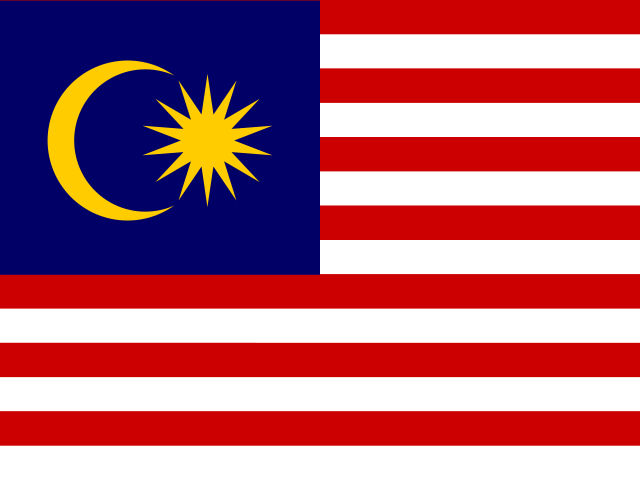 MAS
MAS
|
G | £65k |
| 2 |
MATTHEW DAVIES
|
MAS
|
RB | £85k |
| 3 |
AIDIL ZAFUAN
|
MAS
|
D | £75k |
| 4 |
NORAZLAN RAZALI
|
MAS
|
D | £40k |
| 5 |
ASRARUDDIN OMAR
|
MAS
|
LB | £75k |
| 6 |
BRENDAN GAN
|
MAS
|
RW | £25k |
| 7 |
SAFIQ RAHIM
|
MAS
|
M | £75k |
| 8 |
WAN NOOR
|
MAS
|
M | £65k |
| 9 |
NAZRIN NAWI
|
MAS
|
LW | £30k |
| 10 |
ABDUL YAHYA
|
MAS
|
A | £40k |
| 11 |
AMRI YAHYAH
|
MAS
|
A | £65k |
| 12 |
FARIZAL MARLIAS
|
MAS
|
G | £40k |
| 13 |
MAHALI JASULI
|
MAS
|
RB | £65k |
| 14 |
FADHLI SHAS
|
MAS
|
D | £40k |
| 15 |
K. GURUSAMY
|
MAS
|
M | £65k |
| 16 |
GOPINATHAN RAMACHANDRA
|
MAS
|
A | £30k |
ZAFUAN
RAZALI
OMAR
RAHIM
NOOR
NAWI
YAHYAH