Overview
The North Korea national football team (officially the Democratic People's Republic of Korea, DPR Korea) represents the country in international men’s football. The team is governed by the DPR Korea Football Association and competes in Asian Football Confederation (AFC) and East Asian competitions. Due to the country’s political isolation, the team has had relatively limited exposure compared with many other national sides, but it has produced a few historic moments on the world stage and has enjoyed regional success at various times.
History — key phases
- Early decades (1950s–1960s): Football activity was organized domestically after the foundation of the DPRK. The national team played regional friendlies and matches within socialist bloc tournaments, gradually building experience.
- Rise and 1966 World Cup breakthrough: The team’s most famous early achievement came at the 1966 FIFA World Cup in England. North Korea stunned the football world by advancing from the group stage and defeating Italy 1–0 to reach the quarter-finals. Pak Doo-ik scored the famous goal against Italy; the run ended with a 5–3 loss to Portugal after leading 3–0 early in the quarter-final.
- Cold War and relative isolation (1970s–1990s): After 1966 the team remained a strong regional side but did not reappear at the World Cup. Political isolation and limited contact with many footballing nations constrained exposure; they continued to contest Asian competitions and regional events.
- 21st century and 2010 World Cup return: After decades without World Cup qualification, DPR Korea returned to the global stage at the 2010 FIFA World Cup in South Africa. They qualified through the AFC process and faced Brazil, Portugal and Ivory Coast in the group stage. Although they lost all three matches (including a heavy 7–0 defeat to Portugal), the appearance was a major national milestone. North Korea has continued to compete in AFC and East Asian tournaments with varying results.
- Recent years: The team has remained active in qualification cycles for the Asian Cup and World Cup and in regional tournaments (EAFF East Asian Cup). Results have been mixed, with occasional strong showings in qualifying rounds but also setbacks linked to player availability and limited friendly matches.
Major successes
- 1966 FIFA World Cup — Quarter-finals: The most celebrated achievement in DPR Korea’s history. Progressing to the last eight and defeating Italy is the team’s signature accomplishment.
- AFC and regional competition results: While North Korea has not won the AFC Asian Cup, they have been competitive in Asian qualifying and regional competitions. They have reached latter stages in some Asian Games and East Asian Football Championship (EAFF) editions, and have taken medals at smaller regional tournaments at various times.
- 2010 FIFA World Cup qualification: Qualifying for the 2010 World Cup marked a notable modern-era achievement and returned the team to the global spotlight.
Most notable players
- Pak Doo-ik — The hero of 1966 who scored the crucial goal that beat Italy and helped North Korea reach the quarter-finals. He remains the most iconic player in DPRK football history.
- Yang Song — A key midfielder in modern-era squads (born 1992), involved in youth and senior teams; representative of North Korea’s domestic talent pipeline.
- Ri Myong‑guk — A long-serving goalkeeper who was captain and played for the national team across multiple tournaments including the 2010s; notable for leadership and longevity.
- Ji Yun‑nam — A veteran midfielder who scored a memorable goal in 2010 World Cup qualifying that helped DPR Korea reach the 2010 tournament; he later became a symbol of the 2010 squad.
- Hong Yong‑jo — Forward and captain in the 2000s–2010s era, played a central role in qualification for the 2010 World Cup and in key Asian qualifying matches.
- Choe Song‑yong and other domestic standouts — Several players have been influential domestically and in AFC competitions; due to limited professional transfers abroad, many notable DPRK players are known primarily within Asia.
Notable coaches
- Pak Doo-ik (as a player) — legacy figure: While best known as a player, his 1966 contribution overshadowed many later coaching appointments; the 1966 team’s coach, Kim Kwang‑ho, and staff also gained historic recognition.
- Kim Jong‑hun — Coached the team in the 2010 World Cup qualifying period and led the side into the 2010 tournament; his tenure included the high-profile return to the World Cup.
- Jo Tong‑sop — Served multiple stints as national team coach and led DPR Korea in various AFC competitions and qualifiers during the 2010s.
- Foreign advisers and short-term appointments — From time to time the DPRK FA has engaged foreign coaches or advisors for technical support; however coaching has largely remained in domestic hands, reflecting the football structure within the country.
Context and constraints
North Korea’s football story is shaped by the country’s wider political and social context. Limited international friendlies, restricted player movement abroad, and less media coverage mean detailed information about domestic development and many players/coaches is less widely available than for other nations. Nevertheless, DPR Korea remains a respected competitor within Asia and retains a special place in World Cup folklore because of the 1966 achievement.
Legacy
The 1966 World Cup run remains one of the most enduring legacies of the North Korea national team and is often cited among football’s great underdog stories. The 2010 World Cup return reaffirmed the team’s ability to qualify on merit in AFC competition. North Korea continues to produce disciplined, physically robust teams and occasional standout players who perform at the regional level.
| # | Name | Nat. | Position | Value |
|---|---|---|---|---|
| 1 |
 KIM CHANG-UK KIM CHANG-UK
|
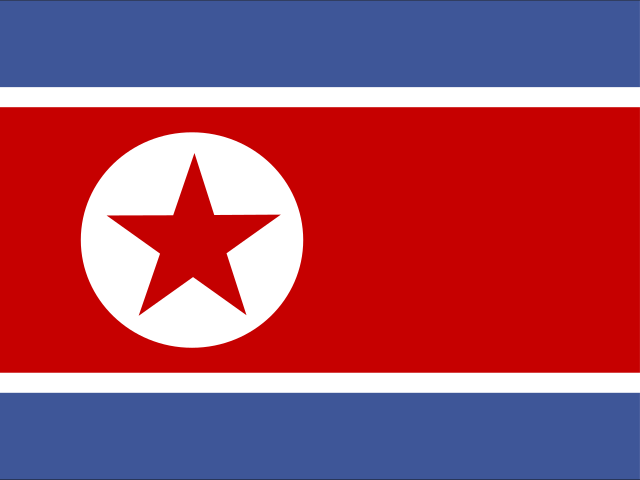 PRK
PRK
|
G | £100k |
| 2 |
KIM GWANG-MIN
|
PRK
|
RB | £100k |
| 3 |
O YONG-NAM
|
PRK
|
LB | £100k |
| 4 |
KIM GYONG II
|
PRK
|
D | £150k |
| 5 |
IM HWA YONG
|
PRK
|
D | £150k |
| 6 |
RYU SONG-GUN
|
PRK
|
RW | £110k |
| 7 |
BAE JONG-MIN
|
PRK
|
LW | £150k |
| 8 |
CHOI WON-NAM
|
PRK
|
M | £200k |
| 9 |
YON JONG-SU
|
PRK
|
A | £150k |
| 10 |
CHOI YONG-SONG
|
PRK
|
M | £160k |
| 11 |
KING YONG-HO
|
PRK
|
A | £130k |
| 12 |
U HONG-CHOL
|
PRK
|
G | £75k |
| 13 |
CHO IN-CHOL
|
PRK
|
D | £85k |
| 14 |
LI YONG-ZIN
|
PRK
|
M | £75k |
| 15 |
BANG GANG-CHOL
|
PRK
|
M | £75k |
| 16 |
GONG MUN-CHOL
|
PRK
|
A | £75k |
II
YONG
YONG-NAM
WON-NAM
YONG-SONG
JONG-MIN
YONG-HO