Overview
The Ghana national soccer team, known as the Black Stars, is one of Africa’s most successful and recognizable national teams. The team is governed by the Ghana Football Association (GFA). Ghana’s colors (black, red, gold and green) and the Black Stars nickname are drawn from national symbolism and the historic Black Star of African emancipation. Ghana has a long footballing heritage, strong youth development tradition, and a passionate domestic and diaspora following.
History
- Early years (1950s–1960s): Organized football in Ghana grew rapidly after independence in 1957. The Black Stars became a continental force quickly, with early success in the Africa Cup of Nations (AFCON).
- Golden era in Africa (1960s–1980s): Ghana won multiple continental titles during this period and regularly produced strong squads for AFCON. The team established itself as a consistent African powerhouse.
- Rebuilding and youth focus (1990s–2000s): Investment in youth development paid dividends. Ghana’s youth teams achieved major success on the world stage, which translated to stronger senior squads.
- Global breakthrough (2006–2014): Ghana qualified for its first FIFA World Cup in 2006 and reached the Round of 16. The 2010 World Cup saw Ghana reach the quarter-finals — the third African team ever to get that far — narrowly losing to Uruguay in a dramatic match decided on penalties. Ghana qualified again in 2014 and continued to be a strong contender in Africa and at the global level.
- Recent years (2015–present): The team has experienced ups and downs, including changes in coaching and administration. Ghana remains a top-tier African national side, regularly qualifying for AFCON and competing for Olympic and World Cup qualification spots. Continued emphasis on scouting home-based talent and the diaspora keeps the talent pipeline active.
Major successes
- Africa Cup of Nations: Ghana has won AFCON four times (1963, 1965, 1978, 1982), making them one of the continent’s historically most successful teams.
- FIFA U-20 World Cup: Ghana won the FIFA U-20 World Cup in 2009 and finished runners-up in 1993. They were the first African nation to win the U-20 title.
- FIFA World Cup: Ghana’s best World Cup performance came in 2010 (South Africa), when they reached the quarter-finals — the furthest any African nation had gone since Cameroon in 1990 and equalled only by later achievements.
- Olympics: Ghana has qualified for Olympic football tournaments and reached notable stages, with growing emphasis on Olympic-age squads in development plans.
Most notable players
- Abedi Pele – A pioneering attacking midfielder for Ghana and the national team in the 1980s–1990s; three-time African Footballer of the Year and a key figure in raising Ghana’s profile internationally. Father of the Ayew brothers.
- Michael Essien – A dominant, box-to-box midfielder known for power and stamina; starred at Lyon and Chelsea (UEFA Champions League winner) and was central to Ghana’s midfield in the 2000s and early 2010s.
- Asamoah Gyan – Ghana’s all-time leading scorer and captain during the 2006–2014 World Cup era; scored crucial goals in World Cup qualification and tournaments, including the 2010 tournament.
- Sulley Muntari – Powerful midfielder noted for long-range shooting and physical presence; part of Ghana’s core in their World Cup runs and continental campaigns.
- Anthony Yeboah – Prominent striker in the 1990s (notably in the Bundesliga and Premier League), he was one of Ghana’s earliest global club stars.
- Samuel Kuffour – Renowned defender who starred for Bayern Munich and was a defensive mainstay for Ghana in major tournaments.
- Kevin-Prince Boateng – Though he had dual-nationality and a complex international career, Boateng represented Ghana at the 2010 World Cup and brought a high club-level profile.
- Gyan, Ayew brothers (André and Jordan Ayew) – André Ayew (son of Abedi Pele) and Jordan Ayew have been key attacking figures across multiple AFCONs and World Cups; André has captained the side and been influential in major tournaments.
- Other notable recent players: Thomas Partey (midfield anchor at Atlético Madrid/Arsenal), Baba Rahman (left back), Jeffrey Schlupp (versatile winger/wingback), and many European-based talents and home-based standouts.
Most notable coaches
- C. K. Gyamfi – A pioneering Ghanaian coach who led Ghana to multiple AFCON titles in the 1960s and was among Africa’s most respected early managers.
- Fred Osam-Duodu – Important figure in Ghanaian coaching history, involved in youth development and national team management across eras.
- Ratomir Dujković (Serbian) – Coached Ghana to their first World Cup qualification in 2006, raising the nation’s global profile.
- Milovan Rajevac (Serbian) – Led Ghana to the 2010 World Cup quarter-finals with a tactically disciplined side; widely credited for the team’s organization and success in South Africa.
- Avram Grant (Israeli) – Managed Ghana at the 2014 World Cup; a high-profile coach who brought experience from European club and international management.
- Local and developmental coaches – Across Ghana’s history, domestic coaches and youth-focused managers have been crucial in talent identification and development that feed the senior team.
Playing style and culture
Ghanaian teams traditionally combine physicality, pace, technical skill, and tactical organization. The national side has a reputation for strong midfield engines, adventurous wingers, and clinical attacking forwards. Youth development—visible in strong U-17 and U-20 results—remains a hallmark of Ghanaian football culture. Football is deeply ingrained in national identity, with a passionate fanbase supporting the Black Stars at home and abroad.
Legacy
Ghana’s legacy in African and world football is significant: multiple AFCON titles, pioneering youth success (including the 2009 U-20 world title), and historic World Cup performances that helped shift perceptions of African teams’ competitiveness on the world stage. The Black Stars continue to be a major force in African football, producing players who succeed in top European leagues and representing Ghana on the global stage.
| # | Name | Nat. | Position | Value |
|---|---|---|---|---|
| 1 |
 ADAM KWARASEY ADAM KWARASEY
|
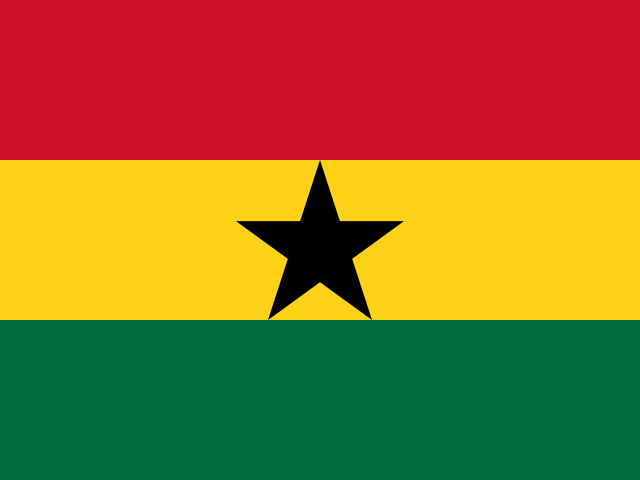 GHA
GHA
|
G | £500k |
| 2 |
HARRISON AFFUL
|
GHA
|
RB | £300k |
| 3 |
ASAMOAH GYAN
|
GHA
|
A | £1.1M |
| 4 |
DANIEL AMARTEY
|
GHA
|
D | £1.1M |
| 5 |
JOHN BOYE
|
GHA
|
D | £600k |
| 6 |
ABDUL RAHMAN BABA
|
GHA
|
LB | £2.25M |
| 7 |
EMMANUEL AGYEMANG-BADU
|
GHA
|
M | £1.3M |
| 8 |
ALFRED DUNCAN
|
GHA
|
M | £1.8M |
| 9 |
CHRISTIAN ATSU
|
GHA
|
RW | £800k |
| 10 |
ANDRE AYEW
|
GHA
|
M | £3.5M |
| 11 |
JEFF SCHLUPP
|
GHA
|
LW | £1.8M |
| 12 |
BRIMAH RAZAK
|
GHA
|
G | £250k |
| 13 |
JONATHAN MENSAH
|
GHA
|
D | £200k |
| 14 |
AFRIYIE ACQUAH
|
GHA
|
M | £800k |
| 15 |
FRANK ACHEAMPONG
|
GHA
|
LW | £1.1M |
| 16 |
JORDAN AYEW
|
GHA
|
A | £1.6M |
AMARTEY
BOYE
BABA
AGYEMANG-BADU
DUNCAN
AYEW
SCHLUPP