GREECE
League
World Cup 94
Coach
MICHAEL SKIBBE
Tactics
4-4-2
Squad Value
£22.4m
Home kit
Alternate kit
Greece national football team — overview, history, successes, notable players and coaches
Brief history
- The Greece national football team (Hellenic Football Federation: Εθνική ομάδα Ελλάδας) played its first official international match in 1929. Before World War II the team was sporadically active; after the war it became a regular participant in regional and European competition.
- For much of its history Greece was regarded as an underdog in European football. Qualifications for major tournaments were rare until the late 20th and early 21st centuries, when structural improvements in the domestic game and generation shifts led to more consistent success.
- Greece made its first FIFA World Cup appearance in 1994 (USA) but exited at the group stage. The team’s profile rose dramatically in the 2000s.
Major successes
- UEFA European Championship 2004 — Champions: Greece’s greatest achievement came at Euro 2004 in Portugal. Coached by Otto Rehhagel, Greece qualified from a tough group and beat hosts Portugal twice (group stage and the final) as well as France and the Czech Republic en route to a stunning tournament victory. The team’s disciplined defensive organization, cohesive squad play and efficient set-piece and counter opportunities produced one of the biggest upsets in international football history.
- UEFA European Championships qualifications & performances: After 2004 Greece qualified regularly for major tournaments: Euro 2008, Euro 2012 (reached quarter-finals), Euro 2016 (group stage). Their run to the Euro 2012 quarter-finals included a memorable group stage draw with Poland and a knockout-stage progression.
- FIFA World Cup: Greece qualified for the World Cup in 1994 and later in 2010. In 2014 they narrowly missed out; the team has not advanced deep into World Cup knockout rounds but qualification itself is notable for a nation with a smaller player pool.
- Consistent defensive identity: Beyond trophies, Greece’s legacy includes establishing a tactical identity built around organization, defensive compactness, and collective discipline — a model that changed perceptions of how smaller footballing nations can compete at the highest level.
Most notable players
- Giorgos Karagounis — Midfielder and captain for many years; known for tireless running, leadership and clutch goals. Key figure at Euro 2004 and later tournaments, he became one of Greece’s most-capped and recognizable players.
- Theofanis Gekas — Prolific striker and top scorer in Greece’s qualifying campaigns (notably Euro 2008 qualification). A clinical finisher whose goals helped Greece reach major tournaments.
- Angelos Charisteas — Scored the winning goal in the Euro 2004 final against Portugal. A focal point in attack during that tournament and a national hero for his decisive contribution.
- Traianos Dellas — Central defender and Euro 2004 captain for part of the tournament; remembered for his aerial strength, leadership and the crucial header he scored in the quarter-final against France (a memorable defensive and set-piece contribution).
- Antonios Nikopolidis — Goalkeeper during Euro 2004, whose saves and calm presence were vital to Greece’s defensive success. He was later named in UEFA’s Team of the Tournament.
- Vassilis Torosidis — Versatile defender/midfielder who became an important leader for Greece across multiple tournaments and served as captain in later years.
- Vassilis Karagounis & other modern figures: Other significant players across eras include Sokratis Papastathopoulos (defender who became a mainstay and captain), Kostas Manolas (central defender), and Dimitris Salpingidis (forward/winger known for his work rate and crucial goals).
Notable coaches
- Otto Rehhagel (Germany) — legendary coach: Rehhagel is the most celebrated coach in Greek football history. Appointed in 2001, he built the defensive, united squad that won Euro 2004. His pragmatic tactics, discipline and ability to create team cohesion transformed Greece into continental champions.
- Fernando Santos (Portugal): Santos took charge in 2010 and restored Greece to consistent qualification for major tournaments. Under him Greece reached Euro 2012 quarter-finals and qualified for the 2014 World Cup. Santos emphasized organization and defensive solidity while adding some tactical flexibility; he later became Portugal’s coach and won Euro 2016 with Portugal.
- Otto’s predecessors and successors: Before Rehhagel and after Santos, Greece had a number of domestic and foreign coaches who contributed to development and transitional periods. These include Greek coaches who helped nurture talent and maintain competitiveness in European qualifying cycles.
Legacy and current outlook
- Greece’s Euro 2004 triumph remains one of football’s greatest underdog stories and reshaped expectations for small and mid-size national teams: structure, teamwork and tactical discipline can overcome individually stronger opponents.
- The national team continues to produce players who perform in European leagues and to compete for qualification to European Championships and World Cups. Development of youth systems and stronger club performances (notably from Olympiacos, Panathinaikos and PAOK) are key to future success.
- Greece’s identity as a tactically disciplined, defensively resilient side endures, and the 2004 team remains a cultural touchstone for Greek football fans.
Summary
Greece’s national team rose from occasional participant to European champion in 2004, thanks to a disciplined, collective approach orchestrated by Otto Rehhagel. Subsequent coaches like Fernando Santos sustained competitiveness, and players such as Karagounis, Charisteas, Dellas and Nikopolidis became icons. The team’s legacy is a model of tactical organization and the reminder that smaller footballing nations can achieve major success through cohesion and strategy.
| # | Name | Nat. | Position | Value |
|---|---|---|---|---|
| 1 |
 ORESTIS KARNEZIS ORESTIS KARNEZIS
|
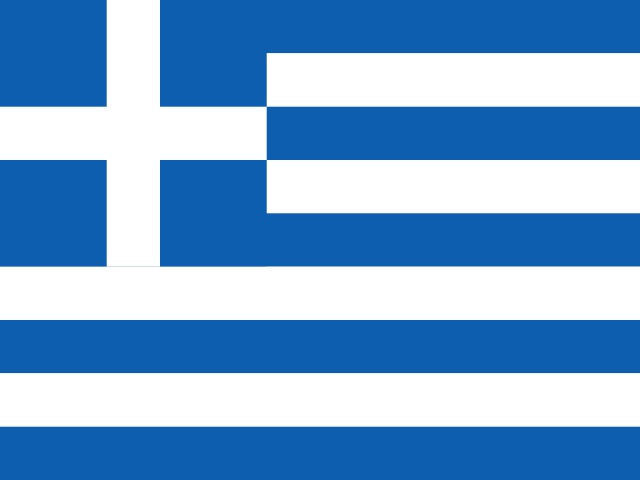 GRE
GRE
|
G | £1.1M |
| 2 |
VASILIS TOROSIDIS
|
GRE
|
RB | £600k |
| 3 |
SOKRATIS
|
GRE
|
D | £4.5M |
| 4 |
KOSTAS MANOLAS
|
GRE
|
D | £4.5M |
| 5 |
YORGOS TZAVELLAS
|
GRE
|
LB | £450k |
| 6 |
NIKOS KARELIS
|
GRE
|
RW | £1M |
| 7 |
ANDREAS SAMARIS
|
GRE
|
M | £1.9M |
| 8 |
KOSTAS FORTOUNIS
|
GRE
|
M | £2M |
| 9 |
 KOSTAS STAFILIDIS KOSTAS STAFILIDIS
|
GRE
|
LW | £700k |
| 10 |
DIMITRIS DIAMANTAKOS
|
GRE
|
A | £450k |
| 11 |
KOSTAS MITROGLOU
|
GRE
|
A | £2.25M |
| 12 |
STEFANOS KAPINO
|
GRE
|
G | £600k |
| 13 |
DIMITRIOS SIOVAS
|
GRE
|
D | £800k |
| 14 |
PANAGIOTIS TACHTSIDIS
|
GRE
|
M | £650k |
| 15 |
PETROS MANTALOS
|
GRE
|
A | £550k |
| 16 |
APOSTOLOS VELLIOS
|
GRE
|
A | £350k |
KARNEZIS
TOROSIDIS
SOKRATIS
MANOLAS
TZAVELLAS
SOKRATIS
MANOLAS
TZAVELLAS
KARELIS
SAMARIS
FORTOUNIS
STAFILIDIS
SAMARIS
FORTOUNIS
STAFILIDIS
DIAMANTAKOS
MITROGLOU
MITROGLOU