Overview
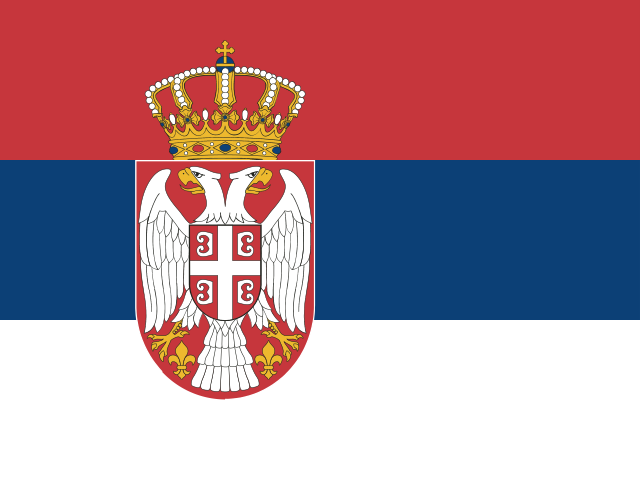
The Serbia national football team represents the Republic of Serbia in international football. Its modern lineage is tied to several historical national teams from the region — most directly to the Serbia and Montenegro team (1992–2006) and earlier to the Yugoslavia national team (1919–1992). After the breakup of Yugoslavia and the subsequent state unions, the present Serbia team has competed independently since 2006 when Montenegro voted for independence and Serbia continued as the successor in FIFA and UEFA records.
History
- Early era — Kingdom of Yugoslavia / Yugoslavia: Organized football in the region produced the Kingdom of Yugoslavia team that competed from the 1920s. Yugoslavia were regular participants in early international competitions, reaching the first FIFA World Cup semi-finals in 1930 and finishing as Olympic silver medallists (e.g., 1948).
- Post‑war Yugoslavia (1946–1992): A strong, technically gifted side that achieved notable results at World Cups and European Championships. Several world-class players emerged from the Yugoslav system.
- FR Yugoslavia / Serbia and Montenegro (1992–2006): After the breakup, the team re‑entered international football and qualified for major tournaments, notably the 1998 FIFA World Cup (reaching the round of 16) and Euro 2000 (reaching quarter-finals). The late 1990s and early 2000s saw a resurgence led by a golden generation of players.
- Independent Serbia (2006–present): Following Montenegro’s independence in 2006, Serbia took over the national team’s records. Serbia has qualified for World Cups (2010, 2018, 2022) and regularly competes in UEFA qualifying and Nations League. Performances have varied: strong qualifying campaigns have sometimes been followed by disappointing tournament group exits, reflecting transition periods and generational change.
Major successes
- As Yugoslavia (counts as part of the historical lineage): two Olympic silver medals (1948, 1952) and consistent strong showings in major tournaments in mid‑20th century.
- Reaching the quarter-finals of Euro 2000 (as Yugoslavia / Yugoslav successor team) — one of the best European Championship runs for the modern lineage.
- 1998 FIFA World Cup: Reached the last 16 (as FR Yugoslavia), marking a successful return to the World Cup stage after the early 1990s disruptions.
- As Serbia (post‑2006): regular qualifications for World Cups (2010, 2018, 2022). While the team has not progressed beyond the group stage at those tournaments, qualification itself and several notable qualifying campaigns represent important achievements for the independent Serbian FA.
Style and reputation
Serbian teams (and their Yugoslav predecessors) have been known for technical skill, creative midfield play, and often strong defensive organization. The region has a reputation for producing technically gifted midfielders and forwards and tactically astute, physically robust players well suited to top European leagues.
Most notable players (historical and modern)
- Sreten “Ferdinand” Popović / older era stars: Early contributors to Yugoslav football development; names from early decades are important historically though less familiar to modern fans.
- Dragan Džajić: Widely regarded as one of the greatest Yugoslav and Serbian players — an outstanding left winger in the 1960s–70s, Ballon d’Or contender, and a symbol of Red Star Belgrade and national success.
- Dejan Savićević: Creative attacking midfielder, a star for Red Star Belgrade and AC Milan in the late 1980s–1990s, key figure in Yugoslavia’s golden years.
- Dragan Stojković Piksi: Elegant playmaker and captain in the 1990s; later became an influential coach.
- Siniša Mihajlović: Renowned defender and free‑kick specialist, had a high-profile club career in Italy and later a managerial career.
- Nemanja Vidić: Central defender, long-time captain of Manchester United, part of United’s dominant late-2000s defense and widely respected internationally.
- Branislav Ivanović: Versatile defender, a key figure at Chelsea during a highly successful club era (Premier League and Champions League successes).
- Dejan Stanković: Dynamic midfielder who played for Lazio and Inter Milan, captained the national side across transitions from Yugoslavia to Serbia and Montenegro to Serbia.
- Zlatko Vujović / older contemporaries: Important forwards across the 1970s–1980s eras for Yugoslavia/Serbia lineage.
- Nemanja Matić: Midfield anchor who played for Chelsea and Manchester United, influential in shielding midfield and ball circulation.
- Dušan Tadić: Creative forward/midfielder and captain in the late 2010s–2020s, influential at Ajax and for Serbia in qualifying campaigns.
- Sergej Milinković-Savić: Powerful, technical midfielder who became one of Serbia’s most important modern talents at club level (Lazio) and internationally.
- Dušan Vlahović: Talented striker emerging in the 2020s, playing at top European clubs and seen as a leading attacking prospect for Serbia.
Notable coaches
- Radomir Antić: Coached the national side (and several club teams) and is respected for his tactical acumen; had successful spells at club level in Spain.
- Vujadin Boškov: Prominent coach with a long career, having led national and club teams, including stewardship in Yugoslav football history.
- Vladislav Petković / 1990s–2000s managers: Several managers guided the team through the turbulent 1990s and into the 2000s qualifying successes.
- Radovan Ćurčić and Dick Advocaat: Managed Serbia (or Serbia and Montenegro successors) during the 2000s–2010s transitional era; Advocaat brought experience from top European management.
- Mladen Krstajić: Former international who managed Serbia in the late 2010s, leading the team during qualifying and tournament cycles.
- Dragan Stojković (as coach): After a distinguished playing career, Stojković became a significant managerial figure, bringing modern ideas; he later coached the national team (appointed 2021) following success at club and international youth levels.
Recent developments
In the 2010s and 2020s Serbia has produced a new generation of players based in top European leagues. The team has been competitive in UEFA Nations League and qualification groups, but has sometimes underperformed at tournaments relative to the talent available. Youth development, diaspora players raised in strong European academies, and a core of experienced professionals have given Serbia a steady presence in international football with potential for deeper tournament runs as the current generation matures.
Legacy
Serbian football’s legacy is intertwined with that of former Yugoslavia: a long tradition of technical, creative players, strong club cultures (notably Red Star Belgrade and Partizan Belgrade), and a steady pipeline of talent to Europe’s top leagues. The modern Serbia national team continues that tradition while seeking consistent major‑tournament success under contemporary management and player development systems.
| # | Name | Nat. | Position | Value |
|---|---|---|---|---|
| 1 |
 VLADIMIR STOJKOVIC VLADIMIR STOJKOVIC
|
 YUG
YUG
|
G | £300k |
| 2 |
BRANISLAV IVANOVIC
|
YUG
|
RB | £2M |
| 3 |
ALEKSANDAR KOLAROV
|
YUG
|
LB | £2M |
| 4 |
NIKOLA MAKSIMOVIC
|
YUG
|
D | £2.25M |
| 5 |
 MATIJA NASTASIC MATIJA NASTASIC
|
YUG
|
D | £2.25M |
| 6 |
DUSAN TADIC
|
YUG
|
LW | £3M |
| 7 |
NEMANJA MATIC
|
YUG
|
M | £6M |
| 8 |
NEMANJA GUDELJ
|
YUG
|
M | £1.5M |
| 9 |
ADEM LJAJIC
|
YUG
|
A | £2M |
| 10 |
ALEKSANDAR MITROVIC
|
YUG
|
A | £2.25M |
| 11 |
ZORAN TOSIC
|
YUG
|
RW | £1.5M |
| 12 |
PREDRAG RAJKOVIC
|
YUG
|
G | £700k |
| 13 |
NENAD TOMOVIC
|
YUG
|
D | £1.1M |
| 14 |
LUKA MILIVOJEVIC
|
YUG
|
M | £1.5M |
| 15 |
LAZAR MARKOVIC
|
YUG
|
RW | £2.75M |
| 16 |
FILIP DJURICIC
|
YUG
|
A | £1M |
MAKSIMOVIC
NASTASIC
KOLAROV
MATIC
GUDELJ
TADIC
MITROVIC